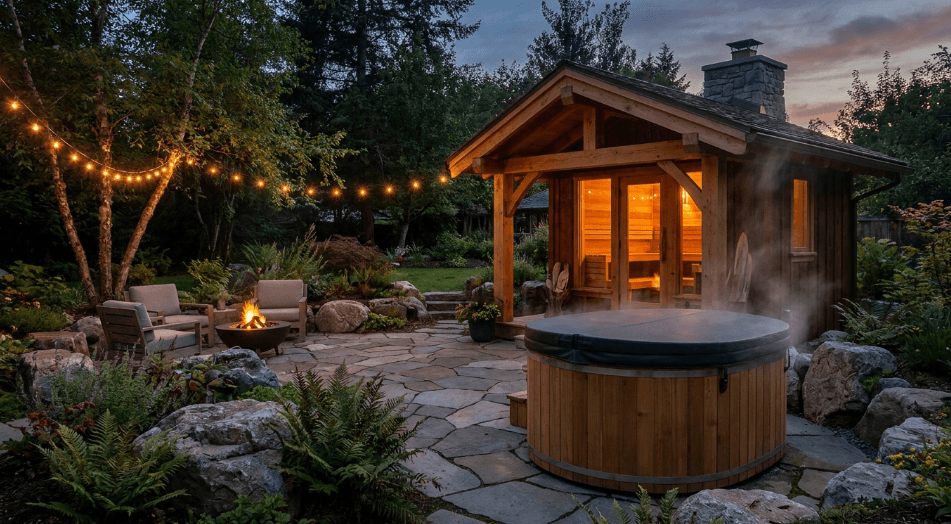
For a tight footprint, prioritize a compact infrared cabin or a narrow two-person barrel over a full traditional cabin: look for a unit under 5 feet square, a heater that plugs into a standard 120V outlet rather than requiring a dedicated 240V circuit, and a clearance spec you’ve actually measured against your room before ordering. A well-chosen small sauna runs $1,800 to $3,500 installed, versus $4,000 and up for a larger traditional build.
Start with the footprint you actually have
Measure the space before shopping, not after. A one-person infrared cabin needs roughly 3 by 3 feet of floor plus a few inches of clearance on each side per the manufacturer’s spec. A two-person version needs closer to 4 by 4 feet. Ceiling height matters too: most compact units need 6.5 to 7 feet minimum, which rules out some basements and attic nooks unless you check the exact model spec first. Write down your actual available footprint in inches before you start comparing units, since listed “interior dimensions” and “footprint including clearance” are two different numbers that get confused often.
Infrared vs. traditional for tight rooms
Infrared panels sit flush against the wall and don’t need the wide clearance zone a stone-topped traditional heater requires around its guard rail. That alone can be the difference between a sauna fitting in a spare closet or bathroom corner and not fitting at all. Infrared units also plug into a standard 120V, 15 or 20 amp outlet, which sidesteps the electrical upgrade a hardwired 240V traditional heater usually needs. The tradeoff is a different experience: infrared runs at a lower ambient temperature, typically 120 to 150 degrees Fahrenheit versus 170 to 190 for a traditional Finnish-style sauna, and it heats the body more directly than the air.
Sizing the heater correctly for a small room
A common contractor rule of thumb sizes traditional sauna heaters at roughly 1kW per 45 to 50 cubic feet of interior room volume. For a small 4 by 4 by 7 foot cabin, that lands around a 2.5 to 3kW heater, well below the 6 to 8kW units larger cabins need. Undersizing makes the room slow to heat and struggle in cold garages or unheated outbuildings; oversizing wastes money on both the unit and the electrical work needed to power it. If the room is in an unheated space during winter, size slightly up from the baseline calculation.
What a small sauna actually costs
A compact plug-in infrared cabin typically runs $1,800 to $3,000 for the unit itself, with minimal installation cost since it just needs a rated outlet nearby. A small traditional cabin with a properly sized heater lands around $2,500 to $4,000 including a licensed electrician’s time for the circuit, if one isn’t already in place. Compare that against $5,000 to $9,000-plus for a full-size traditional build with a larger heater and more extensive electrical work. Checking SweatDecks saunas alongside a couple of other retailers is a reasonable way to get a feel for current pricing across sizes before you commit to a specific footprint.
Ventilation and moisture matter more in small rooms
A compact sauna in a small or enclosed space needs a working vent, typically a small intake near the heater and an exhaust vent near the ceiling on the opposite wall, to keep air circulating properly. In a larger cabin, imperfect airflow is more forgiving; in a tight footprint it shows up faster as stale air or condensation. Confirm the unit includes proper venting and, if it’s going into a basement or interior room without an exterior wall, plan for a way to release humidity after each session so it doesn’t build up in the surrounding space.
Barrel versus cabin for a truly tight footprint
A narrow barrel sauna, roughly 6 feet in diameter, can be the more space-efficient choice for a yard or deck corner since the curved wall lets you tuck it against a fence line in a way a rectangular cabin can’t match. The tradeoff is that barrel units need outdoor placement and a graded or paved pad, while a compact cabin can go indoors in a basement, garage, or closet where a barrel generally can’t. For a genuinely small indoor room, a rectangular infrared cabin uses corner space more efficiently since its flat walls butt right up against two adjoining walls; a barrel’s curve wastes a few inches of floor in the corners it’s set against. Match the shape to where the unit is actually going before comparing prices, since a great deal on a barrel doesn’t help if the space you have is indoors.
Door and glass considerations in a tight room
A door that swings outward needs its own clearance arc counted as part of the footprint, which matters more in a small room than a large one where a few extra inches barely register. Some compact units offer a sliding or bi-fold door specifically to avoid this problem, worth asking about if your intended spot is genuinely tight on approach room. Tempered glass panels or a glass door add a premium of $100 to $300 over a solid wood door but make a small cabin feel noticeably less closed-in, which matters for anyone who finds a fully enclosed small space uncomfortable.
What the research says about lower operating temperatures
Some buyers assume a lower-heat infrared session delivers less benefit than a traditional hot sauna, but the research doesn’t clearly support that. A 2018 review in the American Journal of Physiology examined the physiological effects of heat exposure broadly, including Finnish sauna bathing, and found cardiovascular responses tied more to consistent heat exposure and session frequency than to peak temperature alone. That’s a reasonable argument for choosing whichever format, infrared or traditional, you’ll actually use several times a week in the space you have, rather than assuming hotter is automatically better.
A short buying checklist for tight spaces
Measure your footprint in inches, not feet, before shopping. Confirm ceiling height against the model spec. Decide between 120V plug-in and 240V hardwired based on your electrical setup and willingness to add a circuit. Size the heater to your actual room volume, not a generic “family size” listing. Check for a real venting plan. Confirm return policy and warranty terms, since a small-space purchase is harder to resize later if it turns out too tight for the room.
Frequently Asked Questions
What’s the smallest sauna size that still works well?
A one or two-person cabin, roughly 4 by 4 feet, is the practical floor for a comfortable sit-down session.
Is infrared better than traditional for a small space?
Often yes, since infrared panels need far less clearance than a traditional heater and run on a standard 120V outlet.
How much clearance does a small sauna need from walls?
It varies by unit, typically a few inches for infrared panels and more around a traditional heater guard. Check the exact spec sheet.
Does a small sauna cost less to run?
Yes. A smaller heater rated for a smaller air volume draws meaningfully less power than a large-cabin unit.
Can a small sauna fit in an apartment?
Sometimes, with a plug-in infrared cabin, if the building’s electrical setup allows it. Confirm with building management first.
References
- Cardiovascular and Other Health Benefits of Sauna Bathing: A Review of the Evidence (Mayo Clinic Proceedings, 2018)
- Effects of heat and cold on health, with special reference to Finnish sauna bathing (American Journal of Physiology, 2018)
- Clinical Effects of Regular Dry Sauna Bathing: A Systematic Review. Evidence-Based Complementary and Alternative Medicine, 2018. https://pubmed.ncbi.nlm.nih.gov/29849692/
